Sunday, August 21, 2011

Challenges

Holding 1) a commemorative heart from
the Day of Retreat on July 31, 2011, Santa
María de los Ángeles, "El perdón de Asís"
and 2) new ID from Archbishop's office,
used to enter Abra Prison
For completing work, this past week was more challenging than the preceding one.  Tuesday was a public holiday1 so I did not visit the hospice at Santa Vera Cruz (SVC). I tried to make up that visit today by attending Mass at SVC, and congratulating one of the young hospice residents for joining the Church. This was the confirmation Mass for him and about 20 others from the surrounding community. Unfortunately, however, I was not able to accept his request to serve as his godfather. Having just met him, I was not prepared to fulfill all of the responsibilities accompanying that.

Our weekly teaching schedule at Abra Prison was also disrupted.  Ordinarily we have classes Wednesday through Friday.  However, this week the inmates held a strike in support of a fellow inmate who was not allowed to have a needed surgical operation.  (I don't yet know what operation was needed.) So, on Wednesday, the head of the education program at Abra called us in advance to tell us that we shouldn't bother to make the trip to the prison because we wouldn't be able to cross the protest lines. On Thursday and Friday we called to see if the strike had resolved. Both times we were told that we had better wait until the following week.

So, we had free time and tried to use it well. We examined our teaching materials and planned ahead for several sets of classes.  We also began planning a simple website for teaching English that would provide some on-line support for those San Jose sisters who are unable to continue meeting on Tuesday evenings. Periodic readjustment seems to be a regular part of life and work here. Also it looks like we will be teaching a new English class in our house for two students (Jose Luis and Adrian) on Thursday night after we return from work at the prison. We know Adrian from attending the La Salette Church in our neighborhood. We know Jose Luis from our days of attending the Maryknoll Language School during our first 5 months in Bolivia. Both Adrian and Jose Luis seem to be well educated and are studying English because they want to, so working with them is a pleasure.

I was also able to continue work on a website for a group of women who meet and work at the Franciscan Social Center in Cochabamba. They have difficult family situations and create gift cards as part of their effort to promote environmental consciousness and also to be self-supporting.  The name of their group is T'ikas Warmi, which means Flower Woman in Quechua. Each of their cards is a unique creation from recycled papers, paint, and dried leaves and flowers.  Their results are pretty amazing, I think, and they've amped up production for Navidad '11.  During our June trip to the US, Lynn and I distributed a number of cards in Nashville (The Scarlet Begonia, Logos Bookstore, the gift shop at St. George's Church) and Bloomington, Indiana (Howard's Bookstore), and they were enthusiastically received. More information about the women and their enterprise is available at tikaswarmi.weebly.com.

Yesterday I had an interesting talk with Max, a friend who owns a hardware and building supply store on Avenida Guayacan, a street just a few blocks from our house on Colibri.  Max has interesting ideas about increasing water supply in some of the under-served neighborhoods in this part of the south zone of Cochabamba.  He also wants to create a local business council to better represent the large number of small entrepreneurs here and find new markets for their wares.  Possibly I can help him communicate these ideas. Especially regarding the water project, it would be an achievement to increase or better distribute the supply of potable water in the Cochabamba Valley.  I remind myself that this is the dry season and that the rain will come. However, even with settling the dust currently in the air, Cochabamba will not fully return to the verdant, eternal primavera of its epithet. Max too acknowledged the impact here (hotter, drier, dustier) of climate change.

Our garrafa, hard at work, containing natural gas until we
need it to cook up yet another taste fest.
For residents of our neighborhood, the water problem was complicated recently by another sign of progress, the installation of in-ground lines for distributing natural gas. For cooking, most residents use natural gas in large cylinders called garrafas.  Like many people here, Lynn and I keep a second garrafa so we can continue to cook until we can trade the empty one for a full one.  This is usually done early in the morning when a truck loaded with garrafas circulates through the neighborhoods.  While sometimes the driver sounds a loud horn to alert people that he is near, more often a worker in the back of the truck bangs a metal bar on an empty garrafa to send that unique clang-clang-clang-clang through the early morning air.

That tune will change soon with the installation of the in-ground gas lines.  Bolivia has the second largest known deposits of natural gas in South America. Installation of the new gas lines is a government-sponsored program, and residents here are understandably enthusiastic (cost and convenience) about the progress. However, with growth come growing pains.  It seems that the workers digging the ditches for the new gas lines have also punctured more than a few of the water pipes leading onto people's property.2  These pipes carry water pumped in from the community well.  

With inadequate pressure, water will not flow through the pipes to reach people's sinks, toilets, and so forth. Apparently because of the low pressure and the number of punctured water lines, the administrators of the community well have had to shut off the pump until the leaking lines are located and repaired. Some houses, such as the one we are renting, have reserve tanks for water. When those are depleted or for those without a reserve tank, the recourse is to purchase water from one of the tanker trucks that drive through the neighborhoods. Of course, if we conserve, we have enough water, but not everyone has a reserve tank.
__________

1 The holiday on Tuesday followed the weekend festival of the Virgin of Urqupinia (There are a bunch of video clips on YouTube about this).
2 I think that this would be a likely outcome as the workers must dig all day, day after day, through rock and dirt down to shoulder height, producing a trench that is little more than shoulder width. I later learned another possible incentive--the workers are paid per meter dug.

Sunday, August 14, 2011

Another Good Week, cont'd

A poster on the wall of the
Exaltation Chapel in our neighborhood. It
reminds me that in being alive I have both
rights and responsibilities.
Not recalling the street names on the way to the hospice in Santa Vera Cruz, I splurged on a taxi and then quickly remembered the location as the cab passed south and then turned west toward Petrolero. We passed a large open warehouse surrounded by a wall of wooden crates. The driver said this was where many tomatoes arrived and were disbursed for market throughout the Cochabamba area. At Petrolero we turned south again and in a short time we arrived at the church, Santa Vera Cruz.  I paid for the cab (about $2.10, which included a tip) and made my way into the enclosed grounds through the door and along the open corridor between the church and the school, which was in session. The passageways were old but clean, a welcome contrast to the littered roadsides around Cochabamba.1

When I emerged from the corridor I recognized that I was beside the retreat house. The three-story brick structure appeared to be empty at the moment, but I couldn't tell for sure, just because of closed doors and an empty parking lot.  The hospice was a short way down a dirt road at the bottom of the hill.  As I walked, I saw an old swimming pool off to the left and lapsed into a reverie about swimming pools in my past. I think they represent people's idealism when there actually is time and money enough to relax and enjoy jumping into cool clear water. Maybe the circumstances always change, but for the moment there's that time of enjoyment. Not a bad thing for those lucky enough to have it.

At the gate to the convent and hospice I was welcomed by one of the Calcutta Sisters whom Lynn and I had met there when we first returned to Cochabamba.  She was still cheerful and led me through the sun-filled hallway on the first floor of the hospice. We walked past a young man mopping the floor and exchanged greetings. I was then led into a waiting room until the sister in charge of the hospice could come to speak to me. At this point I really had no idea how I could benefit anyone.  The facility was only recently completed and blessed. It has only three or four residents and also has almost as many volunteers to assist them. I couldn't exactly wish for more terminally ill residents so I could feel good about trying to help them. I wondered if I would spend the morning talking to the other volunteers. Fortunately, that was not to be.

I talked for a while with one of the hospice residents, a Bolivian man older than I. He wanted to know where I was from, how long I had been in Bolivia, and what I was doing here. Beyond that, and wanting to know whether I were a priest, he seemed indifferent to my presence and anything I had to say.  His eyes drifted away or half closed as I talked, and occasionally he drew a long breath and coughed in a way that seemed to unsettle his whole body.  I sensed that he was the one that the head of the facility identified as not wanting to live anymore.  His disease, HIV (here called VIH), was apparently well advanced by the time he sought medical help. According to Sister, he had once had money, and now he was without money. Also, apparently because of the social stigma associated with the disease his family did not want to take care of him.  This unwillingness to care for their own breaks the custom here that families care for their own aged and infirm.  What a powerful disease that it can destroy individuals and social custom. In this guy I could see, from the Franciscan standpoint, my leper.2 While I might not expect to restore his will to live, at least I should be able to interact with him in a way that would declare my own acceptance of him.

The other two residents whom I met there were younger, more mentally agile, and friendly.  When they found out that I taught English language classes they enthusiastically declared that I should teach them.  I agreed to do that, and we set up a plan for me to teach them two hours each morning, using various DVDs that we have and also one of the texts that we bought during our June trip back to the US, Ingles para Latinos. This book is less formally structured than a textbook for a course in English. It focuses on useful phrases and also includes a pronunciation guide for Latinos, a very beneficial addition I think. I had not planned to teach language at the hospice, but I had decided before going there to just see what the interests and needs were and to let my activities develop from that.

After chatting awhile, the four of us--the older man, the two younger ones, and I--had lunch together. The two younger ones kept cracking jokes, and the older guy would respond either with a deadpan look   (I don't believe it was practiced) or a brief remark in what I presumed was Quechua. By the time I left I was convinced that this was going to be a good assignment for Tuesdays. I caught a trufi back down Petrolero toward Suezia, a cut-through street to the other side of the mountains to the west of our neighborhood.  It was a beautiful, sunny, big blue-sky afternoon (you can safely use that tag for 95% of the days here) so I decided to walk the short distance from Petrolero to the east end of Suezia. The air was full of the smells of food from the street vendors, children shouting and the general mid-day hum-a-drum that rises up as gradually more people and vehicles enter the world of transit. When I reached the airplane, the one that marks the east end of Suezia and that was converted into a library for the children, I caught a bus for home.

On Wednesday, Thursday, and Friday Lynn and I taught at Cárcel Abra, the men's prison on the other side of the mountains to the east of our neighborhood.  Because we take a taxi there and sometimes travel on the road over the mountain, I wanted to take some photos (these included below) from the crest as the road passes from one side  over to the other.  I used a Flip HD video camera for these and exported the still frames that were best.  This was hardest on the ascending side because I didn't want to ask the driver to stop, and believe me, image stabilization doesn't do a bit of good if you're trouncing along a rocky, unpaved road. More importantly, however, our days of teaching at the prison this week were good ones:
  • The guards at the entrance were kind enough to let me pass through the checkpoint despite my having left my ID from the Archbishop's office at home.  Since we teach there each week, they know us, but the rule still that no one enters without first leaving their permanent ID there at the checkpoint.  In addition, we also have to leave behind items such as cell phones, phone cards, pocket knives, any medications.
  • The beginners group (we teach two groups, beginners and advanced) seemed to loosen up some, respond to jokes, and contribute more. They get credit for being in class, but they also seemed to want to be there.
  • Three of the men from the advanced group turned in their examinations over the first half of the textbook and did very well. They're learning English grammar, and their pronunciation is good.
  • A group of the soldiers and at the gate into the prison and their commander suggested that we should have an English language class for them as well.  We're going to try to do that.
I can't say that we're changing the lives of the men in prison, but our interactions indicate that we've been accepted, and gradually we begin to know when various ones are feeling up or down, and they likewise seem to detect our moods as well. We don't expect everything to be positive, but it feels as though we can work through the problems there that come our way.

Oh yes, and today at Mass, I was pleased to see that Minh, our friend who is a Maryknoll lay missioner, was with her brother Peter, a Christian Brother who is visiting from New York. In addition, Maggie, a Maryknoll sister, received a blessing before her trip that will take her first back to Ossening, NY and then to Tanzania to visit with her parents. Also at Mass I was struck by the representational figures--muñecas or dolls some might call them--in the chapel. Here there are more of these symbolic figures in church, especially around festival days, such as the current festival, the Virgin of Urkupiñia (Virgin of the Mountain--It is believed that in the 1800s Mary appeared to a young girl). I was also impressed by the far-reaching power of the American cinema and animated film because in one very happy young Cochabambino's arms Buzz Lightyear (see below) seemed to be assuring him everything was A-OK.

And to top it all off, today I had this terrific lunch at the house of Juan Carlos, Lupe, and Lizbeth in which I was served zapallo soup, mote and ispis, and a fine main course of sorubí (breaded) , arroz, plátano, yucca, papas fritas, and all the llajua I cared to drizzle on for extra zest! Now for some photos. Click the photos to view larger images.

Looking northwest toward Cochabamba from the road over
the mountains. The green area in the foreground is the golf
course of the Country Club. Most of the area around
Cochabamba is arid now. Some residents tell us that 20 years
ago it was verdant. The water is part of Laguna Alalay, the
last of 3 lagunas around the city. 
Looking northeast just across the summit from the same road
 over the mountains. Below the slope are the walls and buildings
of Cárcel Abra, the men's prison where Lynn and I teach.
Beyond that is the community of Abra and the city of Sacaba.
Peter and Minh, brother and sister from the United States,
receive communion from Padre Juan Carlos at Capilla Exaltación.
Juan Carlos, a native Bostonian and La Salette priest, gives a
benediction to Maggie, a native Tanzanian and Maryknoll sister,
a couple of days before her trip to the US and back home.
A young parishioner at Exaltation Chapel holding an image
of the Madonna and infant Jesus.
Another young parishioner holding Buzz Lightyear. If you
press a button on Buzz's control panel, his wings pop out.
________
Today at lunch our friend Lizbeth told me that Sucre, known here as the white city, is much cleaner than Cochabamba. I'm not sure why people in Cochabamba litter as much as they do.  To me it seems a little like people feeling that it is their right to drive while drunk if they want to, and apparently there's a lot of that here too among the professional drivers.

2 "One day while riding through the countryside, Francis, the man who loved beauty, who was so picky about food, who hated deformity, came face to face with a leper. Repelled by the appearance and the smell of the leper, Francis nevertheless jumped down from his horse and kissed the hand of the leper. When his kiss of peace was returned, Francis was filled with joy. As he rode off, he turned around for a last wave, and saw that the leper had disappeared. He always looked upon it as a test from God...that he had passed." From Catholic Online.                                                                                                                                         

Thursday, August 11, 2011

Another Good Week

This has been a good week for me because I feel close to the people I work with. Monday was a day to prepare for the classes that Lynn and I teach Wednesday through Saturday.  Admittedly, some of this is just reflecting on what we've done and where we'll go next. (We seem to have developed some credibility at the Archbishop's office, well with the head of Penitencial Pastoral in that we've been reimbursed for photocopying books and handouts, purchasing minor supplies like markers for the whiteboard.) We also consider the problems our students are having, look for examples to help them, create handouts, and  generally get to know our spoken language better,  the way you usually get to know a work of literature better if you read it to teach it rather than just reading it for yourself. Most of this is actually fun because we remember things we've forgotten, discover patterns we never knew, and create material for handouts. The goal is to have a more definite direction when the time for class arrives. After all of these years it still feels good when Lynn and I plan together because we challenge each other's ideas.  Generally this leads to more productive class time, which means, I think, that we spend less time talking about language and more time in teaching practical use of a language and guiding the students' use of it.

Yesterday morning (Tuesday) I made my first trip to the hospice at Santa Vera Cruz (SVC)recently opened by a group of the Calcutta Sisters, Mother Teresa's order, at about kilometer 5 on Petrolero, on the other side of a row of hills to the west of us. This was a good step for me because I have been unsure about the best way to use my service time on Tuesdays:
  • in the Apoyo Escolar (school help) program in Nueve Vera Cruz (a bit further down the road from SVC)
  • in a comparable program in the La Salette Church in our neighborhood
  • begin teaching in another prison, but one with worse conditions for the prisoners, such as San Sebastian
There are good reasons to choose any one of the specific sites because volunteers are needed in each one. However, in the end I chose to work in the hospice at SVC. Actually, serving in the hospice was one of our original prospective service sites when we returned to Cochabamba following a semester of teaching at the Unidad Academica Campesina-Carmen Pampa in the North Yungas. In the search for mission sites in January, we decided to spend the bulk of our time at the prison, partly in honor of our friend Harmon Wray (we observed the anniversary of his death on July 24th), and also because we know that volunteers from the free world are always needed and appreciated by the society within walls.  We also were less certain about what we might be doing as volunteers helping terminally ill patients. Maybe we were afraid of them or more accurately the risk of contracting tuberculosis or HIV.
Regardless, after working a few months in our other sites, this didn't seem to be an issue for me because I knew so little about the populations I was working with.  I just had to remind myself to take appropriate precautions in all of them. After I understood that, working with the hospice population seemed like an interesting challenge.  (More about this week later this week. Oh yes, and if you're headed this way, here's a nice welcome from Marcela who owns and operates the tienda just across the street.  Her bread is always fresh!)

Monday, July 25, 2011

Around our Barrio, cont'd.

A few regulars at the Wednesday morning Breakfast Club
On Wednesday mornings Lynn and I walk about 6 or 7 blocks to the La Salette church.  After Mass we attend an informal breakfast of coffee, tea, bread and warm milk at the priests' house  Mostly this breakfast is a time for fellowship.  We talk about our activities and what we plan to do.  Left to right in this group photo are Lil (Maryknoll sister from Louisville, KY, a vet of the SOA protests, with years of service in Peru and Bolivia), Adrian (a lay Franciscan who sings well, usually heats the milk for breakfast, and recently said he wants to start learning English), Willa (a Maryknoll lay missioner from the United States and a 3rd-year law student at Notre Dame specializing in immigration law), Padre Juan Francisco (a La Salette priest originally from Boston who speaks very good Spanish and always makes everyone feel welcome), Padre David (also a La Salette priest but from Tareja, Bolivia, incredibly always in a good mood, and a specialist at delivering homilies that draw in the whole congregation), Maggie (a Maryknoll sister originally from Tanzania who runs the apoyo escolar program at the comedor and school behind the La Salette church. She's experienced at keeping order among the children, and she welcomed Lynn to help her), Lynn Myrick (a multi-talented FMS lay missioner who loves the children and works in the apoyo escolar program in the mornings on 4 days each week).

Lynn and I on either side of Sister Jacqueline
After breakfast, Lynn and I meet with Sister Jacqueline of the Hermanas Misioneras del Santisimo and several young students who also wish to learn English.  We use the same textbooks for the course as we do for the men at Carcel Abra, Top Notch, and we progress at a rate comfortable for them.  In the few months that we have been meeting with them, they have gained confidence.  Their pronunciation has improved, and it's amazing to see how at first a sound seems difficult to produce and then suddenly they get it right. They especially like to hear songs with words in English.  This is a good break from grammar. When we can, we try to provide them with a copy of the song lyrics so they can practice after class and form questions about the meaning of particular phrases.

Padre David with the children at almuerzo
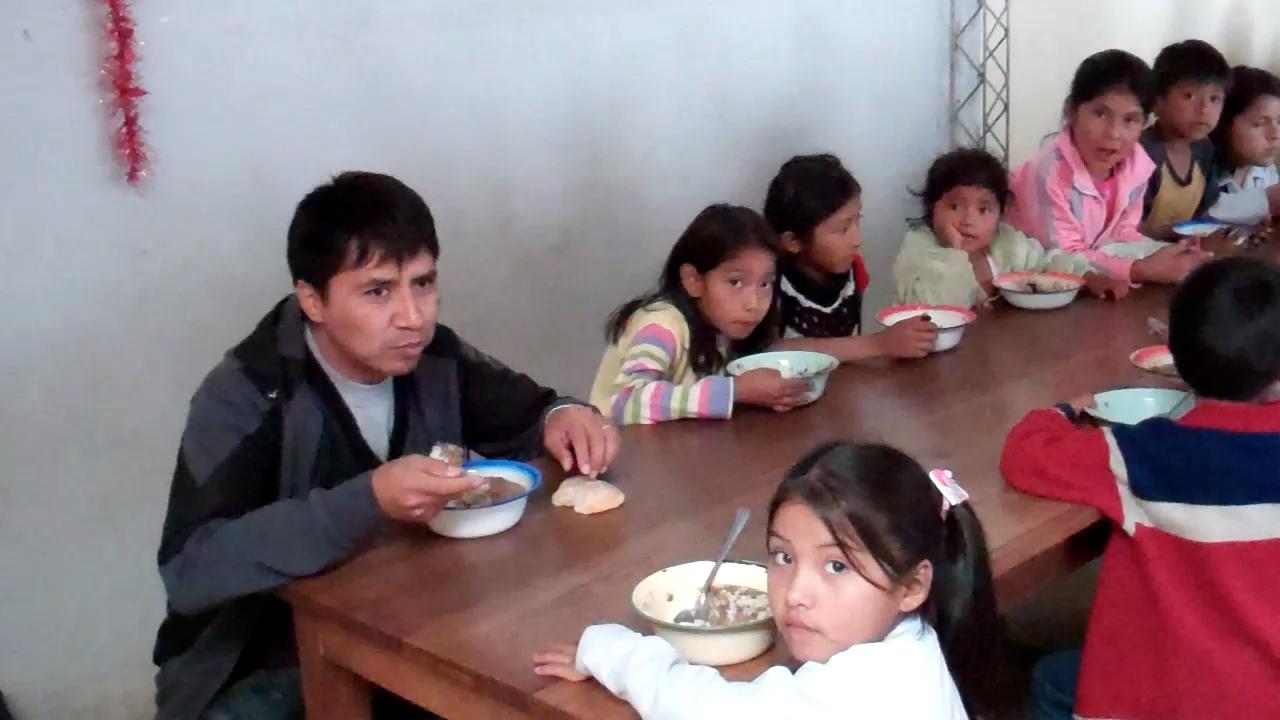
The apoyo escolar program at La Salette Church has been run by the La Salette order for about twelve years.  Before that it was run by the Franciscans. In its present form children can attend before or after school, depending on whether they attend school in the morning or afternoon.  After completing school assignments, they have a light meal of freshly baked bread, soup, and a drink such as api.


Around our Barrio

In June Lynn and I made a trip to the United States to visit family and friends and then returned to Bolivia and our mission work here.  Even though it was difficult to separate ourselves temporarily from Bolivia, it was a good trip, and we won't go back again until the end of our mission term in December of 2012. I think every mission experience has phases of involvement in projects and self reflection. The latter seems to me the way we spent our time away from mission work here.  We were able to think about what we have been doing and why.  We were able to have the direct encounters we needed with the people we are so far away from. It amazes me how quickly all of our lives change and complicate.  It's good to know that people can get along without us, but it also feels good to know that we have been missed.

Before leaving for the United States, we took photos of places where we work and the people we work with.  We also reviewed some of our other photos since moving from Carmen Pampa to Cochabamba (Cbba) in January of this year. I'm glad we did this.  Besides the fact that it makes it easier for us to share the experience with others, it does me good to remember that we really are only here for a short time.  We want to be able to remember the experience ourselves, and while we're here we want to keep at the forefront of our plans the need to make good use of our time.  To me that means enjoying the process of building relationships and also staying focused on the ministry of presence that is central to us as Franciscans and members of Franciscan Mission Service.

Lynn, Joel, and Clare during a board meeting in May 2010
In passing, I have to say that it was hard to say goodbye for a while to fellow FMS missioner Clare Lassiter. She performed excellent work for her volunteer site in Cochabamba (Cbba), Niños con Valor (dedicated to caring for infants with HIV and/or serious birth defects), and that her mission spirit will continue to benefit many whether continues to volunteer in Bolivia or returns to her own family and friends in the United States. We had a lot of fun as classmates during our five month session at the Maryknoll Language Institute, and she was always an insightful contributor to our weekly gatherings after Lynn and I returned to Cbba from Carmen Pampa.

I am also grateful to Clare, Camilla and Kate for house and dog (Blondie) sitting while we were in the US. It's never a good idea to leave a house unattended, but her in Barrio Magisterio, people tell us to be very careful about leaving any valuables unguarded.  Despite the high wall around the property, the barbed wire and broken bottles atop the walls, the deadbolt locks and bars over all the doors and windows, professional thieves seem to view these types of security efforts as enticing problems to solve.

Before I write about our trip to the United States, here are some of those photos of our world in the south end of Cbba. In March, the Diocese of Cochabamba held a day of celebration in which all parishes were invited to celebrate the richness of their culture and faith traditions.

Along with field games of building human pyramids, blind man's bluff (yes, an occasional "Marco!" and "Polo!" could be heard), tag, and numerous types of traditional dancing, all participants could learn more about each other's local churches, share lunch and see how exhilarating it was to be together outside on a beautiful day.  The celebration concluded after Mass was celebrated by Bishop Tito and numerous co-celebrants from the holy orders serving in Cbba.


In April we witnessed a Dia del Peatón here in Cochabamba. This is one of three days during the year in which--for about 7 hours--motorized traffic is not allowed on the streets.  The pavement is then free for more relaxed and less-polluting modes of transport such as scooters, bicycles, skates, and shoes.  There also is no age-limit for the drivers.  It's a very relaxed time, with more refreshments than usual along the way such as vendors with fresh-squeezed orange juice. Peaton days are an enjoyable way to make people more aware of air pollution.

Circuito Bolivia, the road around Laguna Alalay during the dia del peaton in April.

In Cochabamba, many of the cars and minibuses are powered by natural gas rather than gasoline.  Bolivia's large deposits of natural gas make this a less expensive way to power vehicles. Auto mechanic shops that convert vehicles from gasoline to natural gas can be found throughout the city. I'm not sure if the emissions are any less polluting than engines that burn gasoline. On a regular day of traffic, the vehicle density in Cbba is far less than in a US city. However, of the ones on the road, a larger percentage are old and probably pollute more heavily.

We are in the dry season here in Bolivia.  Recently, because the pump for our community well was being serviced, we had to buy water from one of the tank trucks that pass through. On this occasion, when we filled our below-ground reserve tank (there is also a smaller one on top of the house) it cost 60 Bolivianos, about $8.00. This doesn't seem expensive, but it is for some people, and it is also more expensive than paying for water from the community well.  We try to keep our reserve tank filled when there is a good supply of water coming from the community well.

No matter where we go there always seems to be a pack of dogs.  Some have owners. In March or April crews circulated through neighborhoods and vaccinated the dogs against rabies.  The ones vaccinated had a yellow plastic ribbon (Lynn says that it is green, but I think that at most it's yellow-green) placed around their necks.  We put out some food on the sidewalk for the dogs near our house because some of them do not seem to get much food.  I think when they're weak they're more susceptible to attack from the other dogs. Somehow, the children of the neighborhood seem to move through the streets without being bitten. I should say that I haven't heard of anyone being bitten. For fear of that, I'm probably more cautious than the local people.

I have run out of time and will continue with Around our Barrio tonight or tomorrow.

Tuesday, June 14, 2011

Sustaining Idealism (2 Cor 9:6-11)

This month Lynn and I reached the midpoint of our current three-year commitment representing the Franciscan Mission Service as lay missioners here in Bolivia. Among my general responses to being here, I think about some of our challenges.  We are content with our work, and while the challenges we have faced are not overwhelming, knowing them makes it easier to navigate the whole environment. As in my home culture, I must sustain mission idealism through periodic doubt and frustration: 
  • Work interruptions such as strikes and the roadblocks to support them: Both are more common here than in the United States and seem to have more impact on society as a whole that is, the extent to which work can proceed. Such was our experience recently with the diverted traffic load on the high road to Abra.1 
  • Procedures in Bolivia may take more time than I think they should, such as with our recent efforts to renew visas and national identification cards at Immigration Services.2 
  • The sensitivity of my North American immune system to the physical environment here and the necessary adjustments I make to protect or adapt myself.3 
  • Social challenges we face from apparently being perceived as representatives from more affluent societies, or at the very least as easy marks.4 
  • The psychological stress of adjusting to the combined set of challenges.5
In each case I try specific adjustments and with varied results.  With this I still try to be a problem-attacker in the hope that with some of the effort I can be a problem-solver, and I continue to rely on my personal support network of prayer and donations, family and friends back home, as well as fellow missioners and longer-tenured residents and friends here in our host country. I also think that I am very fortunate that Lynn and I are married to each other because we take time to examine what is and isn't working and why.

The difference between my mission work here versus working in the United States is that here I volunteer my labor while trying in my own way to represent Christ's compassion for all. Despite being cheap labor, I do not feel that we are thought of that way by any of those we serve. Without seeking gratitude, we experience a lot of it from the relationships we have developed at our various worksites and from our neighbors.
  • Extent of personal involvement: I think it's better when we work with dedication.  Sometimes, as with working at jobs in the US I feel exhausted, but yes, sometimes that too feels good, remembering that it was time spent interacting with new people, thinking at first that I understood fully but only to gain new insights in the process, generally being well received and learning the local mores, and always feeling closer to others and to a universal and eternal sense of self.
On this journey sometimes the isolation feels good, sometimes the accompaniment feels good.  It all feels like enlightenment, "for the poor, with the poor, as the poor."6

Lynn, Sr. Jaclene, and Olga after
English class at LaSalette Church
in Barrio Magisterio in Zona Sur,
Cochabamba. 
The reality is that any of the negatives are infrequent and embedded in an atmosphere of acceptance and appreciation. I'll focus on that in my next post, but here's a nice shot of Lynn with two of our Wednesday morning English language students, Sister Jaclene and Olga.
__________
1The high road to Abra Carcel passes up and over the chain of mountains near our house, reducing the distance to the Carcel from 20k to about 3k. Of course, there are trade-offs (the high road is a rock and rubble-strewn path rather than the smooth pavement of the low road, and if the low road is blocked because of a strike, the vehicles that must continue to travelgiant buses, heavily loaded trucks may divert to the high road and create blockades of their own as they attempt to careen past each other around the tight switch-back turns. Lynn and I experienced this first hand as our taxi driver attempted to get us to Abra Carcel on time.
2Navigating Immigration Services is always challenging, with long lines and difficult to decipher explanations of what is your next step and why it may take a few more hours than you anticipated. Lynn and I try to stay silent and remain patient, maybe trying to avoid any undue attention that might prompt one of the employees to suggest that we return in several days. Feeling something like caroming pin balls, we eventually reach the end of the process and receive extended visas and renewed national ID cards: we can stay for another year and a half! Somehow it seems that volunteers should not have to labor so hard just to volunteer their time here. Yes, I know that's whimpering.

3Pollen, bacteria (the latest reaction probably from Thai food the night before although I had no symptoms until after our visit to Tiwanaku [Franz Choque was an excellent guide] with Dan and Jarrett), amoebas, altitude.

4Robbery, indignation, okay to target, suitable to be taken advantage of.
5When the amount of time spent with interruptions or disruptions exceeds the time spent toward the primary objective. I remind myself that success isn't measured in completed projects only.
6Thanks, Iggy.


Thursday, April 21, 2011

Activities in Cochabamba

Lynn and I were not idle when we arrived back in Cochabamba, but we have gradually acquired enough activities here that we are busy. Most of these activities associate with mission while teaching English:
  • Thursdays and Fridays from 3 until 5 at Abra Carcel, a men's prison nearby Sacaba, about 3-4 kilometers away from us if we take the high road, which passes directly over the mountains on the east side of Cochabamba and winds down beside the prison. This group includes about 18 students in total; usually all of them are not there at one time;
  • Tuesday night in our house on Colibri Street from 8:30 until 10 with the Sisters of San José, This group includes 3 students; as teachers in a local high school, they are required by their order to study some English language.
  • Wednesday morning from 8 until 9:30 in a meeting room at the La Salette church near our house. This group includes one sister of the Missionary Sisters of Santísimo and three university-level students. This class takes place after 6:45 am Mass at the church, which is followed by a light breakfast in the house of Padre Juan Francisco (he introduced us to the two groups of sisters--San José and Santísimo--and acquainted us with their need to study English), originally from Boston, and Padre David, from Bolivia.  The Mass and breakfast include a group of regulars and visitors.  Gradually, Lynn and I have begun to feel like regulars.
  • Meeting with individuals who live nearby and want to learn or continue to learn English. Ivo and Ernie, two young men in the neighborhood, wanted to practice English conversation and ask questions about grammar, so I blocked out Tuesday at 10 for an hour in our house for when they have time to visit. Lizbeth, a high school student from the neighborhood, wanted to practice English conversation either in our home or hers for an hour at noon on Saturdays. This past Saturday Lynn and I shared the noonday meal with her family and talked.  They have invited us back to share their family's Good Friday Feast of 10 Plates
  • Meeting (Lynn or me, or both) for an hour on Friday morning with Sister Erika at the La Salette church. I think she is also one of the Sisters of San José. She also bakes great bread, which she shares at the Wednesday morning breakfast.
  • Serving on Wednesdays in the before school/after school programs at Nuevo Vera Cruz (may not have spelled that correctly) under the direction of Padre Pancho (Frank), a Maryknoll priest.  This is a new effort on my part, and I hope to begin next Wednesday.  The children are elementary school aged and live either in the neighborhoods around Nuevo Vera Cruz or come in from further out in the countryside, the campo.
  • Working with a group of women who meet at the Franciscan Health Center to help develop a brochure and web presence for their business of designing, creating, and selling gift cards.  I am just beginning with this effort, so at this point I'm taking photos and learning about the business. I believe the women have been the victims of violence and are providing the sole income for their households.  
Any one of the points above merits elaboration, and I'll make time for that.  However, in general, I'll say that in all of the instances of our teaching English, including teaching at Abra Carcel, we are doing what the people have asked us to do. That is, based on our educational/work backgrounds, or in some instances maybe just because we look like we probably do speak English1, in each instance we have been asked by the people if we would be willing to teach our language.  In agreeing to do this, we purchased with our own money copies of the same basic English language books used by a local school for English language instruction.  We also present the material as though we were progressing through it so the students could qualify for course credit.  Based on the level of interest/participation and other external factors like transportation disruptions due to blockades, strikes, and public holidays, we proceed.  In addition, how this becomes mission for us is that all of our encounters become opportunities to be the best representatives of Christ's presence that we can be. In that we try to accompany the various individuals in their life journeys rather than trying to impress an agenda on them. Invariably part of every class or conversation sharing time becomes a cross-cultural exchange, a cross-individual exchange, a mixture of languages (Spanish, English, and occasional Quechua or Aymara phrases thrown in), and with all of this deepening relationships begin to form as we share some of our lives with each other.2
So English language is being taught, but along the way, we hope, a lot of other beneficial learning for life is taking place.
_________
1I would look like I was from the United States even if I paid a team of local image consultants to outfit me in full Andean plumage....no, I haven't bothered to try it, but I marvel at the local results at carnaval time.)
2This was also part of our experience while teaching at Carmen Pampa, a very gratifying experience with some of the students when time permitted (although a for-credit class does require a more focused approach) after class and with some of the children from the Carmen Pampa community who frequented the children's library. Our time at Carmen Pampa was a very good mission opportunity.