Thursday, August 11, 2011

Another Good Week

This has been a good week for me because I feel close to the people I work with. Monday was a day to prepare for the classes that Lynn and I teach Wednesday through Saturday.  Admittedly, some of this is just reflecting on what we've done and where we'll go next. (We seem to have developed some credibility at the Archbishop's office, well with the head of Penitencial Pastoral in that we've been reimbursed for photocopying books and handouts, purchasing minor supplies like markers for the whiteboard.) We also consider the problems our students are having, look for examples to help them, create handouts, and  generally get to know our spoken language better,  the way you usually get to know a work of literature better if you read it to teach it rather than just reading it for yourself. Most of this is actually fun because we remember things we've forgotten, discover patterns we never knew, and create material for handouts. The goal is to have a more definite direction when the time for class arrives. After all of these years it still feels good when Lynn and I plan together because we challenge each other's ideas.  Generally this leads to more productive class time, which means, I think, that we spend less time talking about language and more time in teaching practical use of a language and guiding the students' use of it.

Yesterday morning (Tuesday) I made my first trip to the hospice at Santa Vera Cruz (SVC)recently opened by a group of the Calcutta Sisters, Mother Teresa's order, at about kilometer 5 on Petrolero, on the other side of a row of hills to the west of us. This was a good step for me because I have been unsure about the best way to use my service time on Tuesdays:
  • in the Apoyo Escolar (school help) program in Nueve Vera Cruz (a bit further down the road from SVC)
  • in a comparable program in the La Salette Church in our neighborhood
  • begin teaching in another prison, but one with worse conditions for the prisoners, such as San Sebastian
There are good reasons to choose any one of the specific sites because volunteers are needed in each one. However, in the end I chose to work in the hospice at SVC. Actually, serving in the hospice was one of our original prospective service sites when we returned to Cochabamba following a semester of teaching at the Unidad Academica Campesina-Carmen Pampa in the North Yungas. In the search for mission sites in January, we decided to spend the bulk of our time at the prison, partly in honor of our friend Harmon Wray (we observed the anniversary of his death on July 24th), and also because we know that volunteers from the free world are always needed and appreciated by the society within walls.  We also were less certain about what we might be doing as volunteers helping terminally ill patients. Maybe we were afraid of them or more accurately the risk of contracting tuberculosis or HIV.
Regardless, after working a few months in our other sites, this didn't seem to be an issue for me because I knew so little about the populations I was working with.  I just had to remind myself to take appropriate precautions in all of them. After I understood that, working with the hospice population seemed like an interesting challenge.  (More about this week later this week. Oh yes, and if you're headed this way, here's a nice welcome from Marcela who owns and operates the tienda just across the street.  Her bread is always fresh!)

Monday, July 25, 2011

Around our Barrio, cont'd.

A few regulars at the Wednesday morning Breakfast Club
On Wednesday mornings Lynn and I walk about 6 or 7 blocks to the La Salette church.  After Mass we attend an informal breakfast of coffee, tea, bread and warm milk at the priests' house  Mostly this breakfast is a time for fellowship.  We talk about our activities and what we plan to do.  Left to right in this group photo are Lil (Maryknoll sister from Louisville, KY, a vet of the SOA protests, with years of service in Peru and Bolivia), Adrian (a lay Franciscan who sings well, usually heats the milk for breakfast, and recently said he wants to start learning English), Willa (a Maryknoll lay missioner from the United States and a 3rd-year law student at Notre Dame specializing in immigration law), Padre Juan Francisco (a La Salette priest originally from Boston who speaks very good Spanish and always makes everyone feel welcome), Padre David (also a La Salette priest but from Tareja, Bolivia, incredibly always in a good mood, and a specialist at delivering homilies that draw in the whole congregation), Maggie (a Maryknoll sister originally from Tanzania who runs the apoyo escolar program at the comedor and school behind the La Salette church. She's experienced at keeping order among the children, and she welcomed Lynn to help her), Lynn Myrick (a multi-talented FMS lay missioner who loves the children and works in the apoyo escolar program in the mornings on 4 days each week).

Lynn and I on either side of Sister Jacqueline
After breakfast, Lynn and I meet with Sister Jacqueline of the Hermanas Misioneras del Santisimo and several young students who also wish to learn English.  We use the same textbooks for the course as we do for the men at Carcel Abra, Top Notch, and we progress at a rate comfortable for them.  In the few months that we have been meeting with them, they have gained confidence.  Their pronunciation has improved, and it's amazing to see how at first a sound seems difficult to produce and then suddenly they get it right. They especially like to hear songs with words in English.  This is a good break from grammar. When we can, we try to provide them with a copy of the song lyrics so they can practice after class and form questions about the meaning of particular phrases.

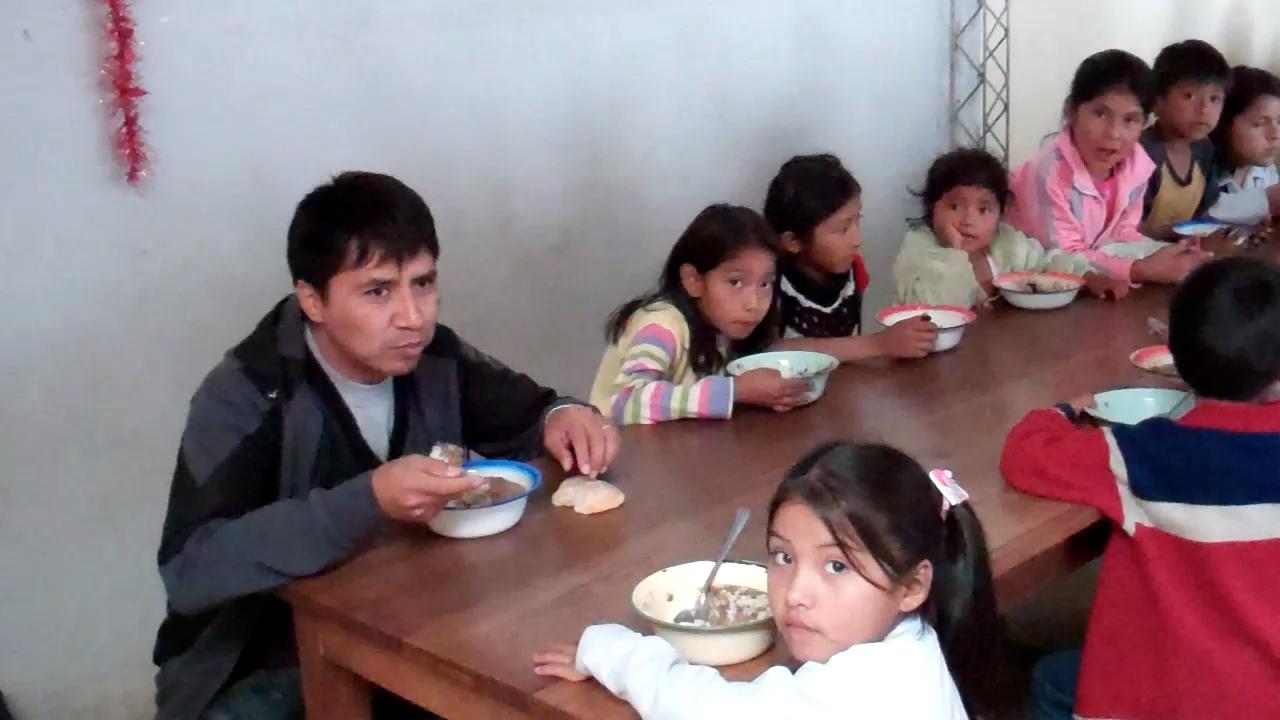
Padre David with the children at almuerzo
The apoyo escolar program at La Salette Church has been run by the La Salette order for about twelve years.  Before that it was run by the Franciscans. In its present form children can attend before or after school, depending on whether they attend school in the morning or afternoon.  After completing school assignments, they have a light meal of freshly baked bread, soup, and a drink such as api.


Around our Barrio

In June Lynn and I made a trip to the United States to visit family and friends and then returned to Bolivia and our mission work here.  Even though it was difficult to separate ourselves temporarily from Bolivia, it was a good trip, and we won't go back again until the end of our mission term in December of 2012. I think every mission experience has phases of involvement in projects and self reflection. The latter seems to me the way we spent our time away from mission work here.  We were able to think about what we have been doing and why.  We were able to have the direct encounters we needed with the people we are so far away from. It amazes me how quickly all of our lives change and complicate.  It's good to know that people can get along without us, but it also feels good to know that we have been missed.

Before leaving for the United States, we took photos of places where we work and the people we work with.  We also reviewed some of our other photos since moving from Carmen Pampa to Cochabamba (Cbba) in January of this year. I'm glad we did this.  Besides the fact that it makes it easier for us to share the experience with others, it does me good to remember that we really are only here for a short time.  We want to be able to remember the experience ourselves, and while we're here we want to keep at the forefront of our plans the need to make good use of our time.  To me that means enjoying the process of building relationships and also staying focused on the ministry of presence that is central to us as Franciscans and members of Franciscan Mission Service.

Lynn, Joel, and Clare during a board meeting in May 2010
In passing, I have to say that it was hard to say goodbye for a while to fellow FMS missioner Clare Lassiter. She performed excellent work for her volunteer site in Cochabamba (Cbba), Niños con Valor (dedicated to caring for infants with HIV and/or serious birth defects), and that her mission spirit will continue to benefit many whether continues to volunteer in Bolivia or returns to her own family and friends in the United States. We had a lot of fun as classmates during our five month session at the Maryknoll Language Institute, and she was always an insightful contributor to our weekly gatherings after Lynn and I returned to Cbba from Carmen Pampa.

I am also grateful to Clare, Camilla and Kate for house and dog (Blondie) sitting while we were in the US. It's never a good idea to leave a house unattended, but her in Barrio Magisterio, people tell us to be very careful about leaving any valuables unguarded.  Despite the high wall around the property, the barbed wire and broken bottles atop the walls, the deadbolt locks and bars over all the doors and windows, professional thieves seem to view these types of security efforts as enticing problems to solve.

Before I write about our trip to the United States, here are some of those photos of our world in the south end of Cbba. In March, the Diocese of Cochabamba held a day of celebration in which all parishes were invited to celebrate the richness of their culture and faith traditions.

Along with field games of building human pyramids, blind man's bluff (yes, an occasional "Marco!" and "Polo!" could be heard), tag, and numerous types of traditional dancing, all participants could learn more about each other's local churches, share lunch and see how exhilarating it was to be together outside on a beautiful day.  The celebration concluded after Mass was celebrated by Bishop Tito and numerous co-celebrants from the holy orders serving in Cbba.


In April we witnessed a Dia del Peatón here in Cochabamba. This is one of three days during the year in which--for about 7 hours--motorized traffic is not allowed on the streets.  The pavement is then free for more relaxed and less-polluting modes of transport such as scooters, bicycles, skates, and shoes.  There also is no age-limit for the drivers.  It's a very relaxed time, with more refreshments than usual along the way such as vendors with fresh-squeezed orange juice. Peaton days are an enjoyable way to make people more aware of air pollution.

Circuito Bolivia, the road around Laguna Alalay during the dia del peaton in April.

In Cochabamba, many of the cars and minibuses are powered by natural gas rather than gasoline.  Bolivia's large deposits of natural gas make this a less expensive way to power vehicles. Auto mechanic shops that convert vehicles from gasoline to natural gas can be found throughout the city. I'm not sure if the emissions are any less polluting than engines that burn gasoline. On a regular day of traffic, the vehicle density in Cbba is far less than in a US city. However, of the ones on the road, a larger percentage are old and probably pollute more heavily.

We are in the dry season here in Bolivia.  Recently, because the pump for our community well was being serviced, we had to buy water from one of the tank trucks that pass through. On this occasion, when we filled our below-ground reserve tank (there is also a smaller one on top of the house) it cost 60 Bolivianos, about $8.00. This doesn't seem expensive, but it is for some people, and it is also more expensive than paying for water from the community well.  We try to keep our reserve tank filled when there is a good supply of water coming from the community well.

No matter where we go there always seems to be a pack of dogs.  Some have owners. In March or April crews circulated through neighborhoods and vaccinated the dogs against rabies.  The ones vaccinated had a yellow plastic ribbon (Lynn says that it is green, but I think that at most it's yellow-green) placed around their necks.  We put out some food on the sidewalk for the dogs near our house because some of them do not seem to get much food.  I think when they're weak they're more susceptible to attack from the other dogs. Somehow, the children of the neighborhood seem to move through the streets without being bitten. I should say that I haven't heard of anyone being bitten. For fear of that, I'm probably more cautious than the local people.

I have run out of time and will continue with Around our Barrio tonight or tomorrow.

Tuesday, June 14, 2011

Sustaining Idealism (2 Cor 9:6-11)

This month Lynn and I reached the midpoint of our current three-year commitment representing the Franciscan Mission Service as lay missioners here in Bolivia. Among my general responses to being here, I think about some of our challenges.  We are content with our work, and while the challenges we have faced are not overwhelming, knowing them makes it easier to navigate the whole environment. As in my home culture, I must sustain mission idealism through periodic doubt and frustration: 
  • Work interruptions such as strikes and the roadblocks to support them: Both are more common here than in the United States and seem to have more impact on society as a whole that is, the extent to which work can proceed. Such was our experience recently with the diverted traffic load on the high road to Abra.1 
  • Procedures in Bolivia may take more time than I think they should, such as with our recent efforts to renew visas and national identification cards at Immigration Services.2 
  • The sensitivity of my North American immune system to the physical environment here and the necessary adjustments I make to protect or adapt myself.3 
  • Social challenges we face from apparently being perceived as representatives from more affluent societies, or at the very least as easy marks.4 
  • The psychological stress of adjusting to the combined set of challenges.5
In each case I try specific adjustments and with varied results.  With this I still try to be a problem-attacker in the hope that with some of the effort I can be a problem-solver, and I continue to rely on my personal support network of prayer and donations, family and friends back home, as well as fellow missioners and longer-tenured residents and friends here in our host country. I also think that I am very fortunate that Lynn and I are married to each other because we take time to examine what is and isn't working and why.

The difference between my mission work here versus working in the United States is that here I volunteer my labor while trying in my own way to represent Christ's compassion for all. Despite being cheap labor, I do not feel that we are thought of that way by any of those we serve. Without seeking gratitude, we experience a lot of it from the relationships we have developed at our various worksites and from our neighbors.
  • Extent of personal involvement: I think it's better when we work with dedication.  Sometimes, as with working at jobs in the US I feel exhausted, but yes, sometimes that too feels good, remembering that it was time spent interacting with new people, thinking at first that I understood fully but only to gain new insights in the process, generally being well received and learning the local mores, and always feeling closer to others and to a universal and eternal sense of self.
On this journey sometimes the isolation feels good, sometimes the accompaniment feels good.  It all feels like enlightenment, "for the poor, with the poor, as the poor."6

Lynn, Sr. Jaclene, and Olga after
English class at LaSalette Church
in Barrio Magisterio in Zona Sur,
Cochabamba. 
The reality is that any of the negatives are infrequent and embedded in an atmosphere of acceptance and appreciation. I'll focus on that in my next post, but here's a nice shot of Lynn with two of our Wednesday morning English language students, Sister Jaclene and Olga.
__________
1The high road to Abra Carcel passes up and over the chain of mountains near our house, reducing the distance to the Carcel from 20k to about 3k. Of course, there are trade-offs (the high road is a rock and rubble-strewn path rather than the smooth pavement of the low road, and if the low road is blocked because of a strike, the vehicles that must continue to travelgiant buses, heavily loaded trucks may divert to the high road and create blockades of their own as they attempt to careen past each other around the tight switch-back turns. Lynn and I experienced this first hand as our taxi driver attempted to get us to Abra Carcel on time.
2Navigating Immigration Services is always challenging, with long lines and difficult to decipher explanations of what is your next step and why it may take a few more hours than you anticipated. Lynn and I try to stay silent and remain patient, maybe trying to avoid any undue attention that might prompt one of the employees to suggest that we return in several days. Feeling something like caroming pin balls, we eventually reach the end of the process and receive extended visas and renewed national ID cards: we can stay for another year and a half! Somehow it seems that volunteers should not have to labor so hard just to volunteer their time here. Yes, I know that's whimpering.

3Pollen, bacteria (the latest reaction probably from Thai food the night before although I had no symptoms until after our visit to Tiwanaku [Franz Choque was an excellent guide] with Dan and Jarrett), amoebas, altitude.

4Robbery, indignation, okay to target, suitable to be taken advantage of.
5When the amount of time spent with interruptions or disruptions exceeds the time spent toward the primary objective. I remind myself that success isn't measured in completed projects only.
6Thanks, Iggy.


Thursday, April 21, 2011

Activities in Cochabamba

Lynn and I were not idle when we arrived back in Cochabamba, but we have gradually acquired enough activities here that we are busy. Most of these activities associate with mission while teaching English:
  • Thursdays and Fridays from 3 until 5 at Abra Carcel, a men's prison nearby Sacaba, about 3-4 kilometers away from us if we take the high road, which passes directly over the mountains on the east side of Cochabamba and winds down beside the prison. This group includes about 18 students in total; usually all of them are not there at one time;
  • Tuesday night in our house on Colibri Street from 8:30 until 10 with the Sisters of San José, This group includes 3 students; as teachers in a local high school, they are required by their order to study some English language.
  • Wednesday morning from 8 until 9:30 in a meeting room at the La Salette church near our house. This group includes one sister of the Missionary Sisters of Santísimo and three university-level students. This class takes place after 6:45 am Mass at the church, which is followed by a light breakfast in the house of Padre Juan Francisco (he introduced us to the two groups of sisters--San José and Santísimo--and acquainted us with their need to study English), originally from Boston, and Padre David, from Bolivia.  The Mass and breakfast include a group of regulars and visitors.  Gradually, Lynn and I have begun to feel like regulars.
  • Meeting with individuals who live nearby and want to learn or continue to learn English. Ivo and Ernie, two young men in the neighborhood, wanted to practice English conversation and ask questions about grammar, so I blocked out Tuesday at 10 for an hour in our house for when they have time to visit. Lizbeth, a high school student from the neighborhood, wanted to practice English conversation either in our home or hers for an hour at noon on Saturdays. This past Saturday Lynn and I shared the noonday meal with her family and talked.  They have invited us back to share their family's Good Friday Feast of 10 Plates
  • Meeting (Lynn or me, or both) for an hour on Friday morning with Sister Erika at the La Salette church. I think she is also one of the Sisters of San José. She also bakes great bread, which she shares at the Wednesday morning breakfast.
  • Serving on Wednesdays in the before school/after school programs at Nuevo Vera Cruz (may not have spelled that correctly) under the direction of Padre Pancho (Frank), a Maryknoll priest.  This is a new effort on my part, and I hope to begin next Wednesday.  The children are elementary school aged and live either in the neighborhoods around Nuevo Vera Cruz or come in from further out in the countryside, the campo.
  • Working with a group of women who meet at the Franciscan Health Center to help develop a brochure and web presence for their business of designing, creating, and selling gift cards.  I am just beginning with this effort, so at this point I'm taking photos and learning about the business. I believe the women have been the victims of violence and are providing the sole income for their households.  
Any one of the points above merits elaboration, and I'll make time for that.  However, in general, I'll say that in all of the instances of our teaching English, including teaching at Abra Carcel, we are doing what the people have asked us to do. That is, based on our educational/work backgrounds, or in some instances maybe just because we look like we probably do speak English1, in each instance we have been asked by the people if we would be willing to teach our language.  In agreeing to do this, we purchased with our own money copies of the same basic English language books used by a local school for English language instruction.  We also present the material as though we were progressing through it so the students could qualify for course credit.  Based on the level of interest/participation and other external factors like transportation disruptions due to blockades, strikes, and public holidays, we proceed.  In addition, how this becomes mission for us is that all of our encounters become opportunities to be the best representatives of Christ's presence that we can be. In that we try to accompany the various individuals in their life journeys rather than trying to impress an agenda on them. Invariably part of every class or conversation sharing time becomes a cross-cultural exchange, a cross-individual exchange, a mixture of languages (Spanish, English, and occasional Quechua or Aymara phrases thrown in), and with all of this deepening relationships begin to form as we share some of our lives with each other.2
So English language is being taught, but along the way, we hope, a lot of other beneficial learning for life is taking place.
_________
1I would look like I was from the United States even if I paid a team of local image consultants to outfit me in full Andean plumage....no, I haven't bothered to try it, but I marvel at the local results at carnaval time.)
2This was also part of our experience while teaching at Carmen Pampa, a very gratifying experience with some of the students when time permitted (although a for-credit class does require a more focused approach) after class and with some of the children from the Carmen Pampa community who frequented the children's library. Our time at Carmen Pampa was a very good mission opportunity.

Tuesday, April 19, 2011

Que el poder esté contigo

Midway during our first semester at Unidad Academica Campesina-Carmen Pampa, Lynn and I realized we weren't happy enough there to continue doing our best work.  We also had a little more than two years remaining on our contract with Franciscan Mission Service.  From our perspective, it made sense to look for a different work site. As we understood our organization's perspective, they preferred that we seek new mission sites within the city of Cochabamba if we did not think we could stay and work at UAC-CP for the remaining two years. We appreciated their emphasis on forming longer-term relationships in mission. We also appreciated the difficult challenges that UAC-CP and the other UAC locations in Bolivia face in providing education for very capable students from more remote areas.
We thought about this for a long time during December. Lynn returned for two weeks to the US to visit a sick friend of ours.  I remained in La Paz for the first week of that time to read, write, walk around, and think. At the end of the year, which coincided with the end of term, we still felt that moving was best for all.

During January Lynn and I completed two bus trips from Carmen Pampa to Cochabamba to transport our four immense suitcases, some books, and furnishings (two folding chairs and an exercise machine) to Cochabamba and to vacate the very nice small apartment where we had stayed on the upper campus of UAC-CP. We had many good and memorable experiences along the way. (I hope to reflect on these in the coming week as I also attempt to bring my blog up to date about our current activities in and around Cochabamba Yes, things are going well with us here, and we hope the same for UAC-CP.)

Thursday, January 27, 2011

Cooling Our Heels During the Blockade

In La Paz During the Cocalero's Blockade of the Roads Into the Yungas

A trail cutting through the last switch-
back on the way to the upper campus
As the spring semester (August through December here in Bolivia) at UAC-CP progressed, Lynn and I felt increasingly more pressed as we tried to plan and conduct effective classes on the upper and lower campuses.  The daily treks up and down, despite my knee and back pain, were a welcome relief.  No matter what the weather, the surrounding terrain is just too beautiful not to lift your spirits even when we were behind schedule and hustling up and down the steep cut-throughs to save time from travelling the entire switchback road. There were enough cancelled classes that we sometimes had to re-motivate ourselves against the loss of momentum.  This was complicated by our need to understand our students' levels of ability, interest and determination.  The intercarreras and faculty retreat were enjoyable and were probably needed breaks, but they also seemed to widen the gap between us and our students as we tried to maintain class schedules.

We were then stranded in La Paz for a week during the cocaleros' blockade of the roads into the Yungas. We didn't need a break from classes, but that was what we had. During that time we tried to take care of personal business (we spent most of one morning using Skype to verify the validity of our health insurance) and to learn more about Bolivian society and culture. We also made friends with the waitresses in the Banais, a restaurant on the street beside San Francisco Plaza. They gave me a copy of their bilingual menu that I could use for the English language students in the Department of Ecotourism.

During most of the week we stayed at the Maryknoll House in Barrio Sopacachi. Besides getting to talk about Bolivian history with Fathers Mike and Joe, both of whom live in the house and have years of mission experience in Latin America, we got to know the staff there--Irma, Rosemary, Grover, Paula, Freida and her sons, and Dora. They were sympathetic about our desire to return to Carmen Pampa but assured us that it was best not to cross the blockade lines. With their hospitality it was much easier to accept this unscheduled vacation.

Three priests from the United States at the Maryknoll House
in La Paz. Larry, on the right, served 50 years on mission
 in Bolivia and accompanied Jack Higgins as one of the
original Maryknollers to come to Bolivia
from the United States in the 1950s. 
Among the guests we met while we were there at the Maryknoll House was Barbara.  Originally from Germany, she had lived for years in Coroico and La Paz, was now living in California near her children and was visiting friends in Coroico when she got out just ahead of the blockade.  Barbara wore her long white hair in a braid. She had a broad smile and a twinkling eye that seemed to squint if she doubted what you were saying. With me, she seemed to squint frequently.

Some of the other guests we met there fit the small world category. For example, Larry, a retired priest with fifty years of mission experience in Bolivia, had also returned to visit friends.  With that many years of service in Bolivia, I thought Larry might have come across Jack Higgins, a Maryknoll priest and the brother of Bitsy Thompson, a member of one parish we belonged to in Nashville, Holy Rosary. When Lynn and I were about to leave the US for Bolivia Bitsy contacted us to wish us good luck in a country her brother had journeyed to about a half century earlier. "The colonel?" Larry said. "Oh, sure, we came down here together--the first group of Maryknollers to come here.  Jack was a great guy, academic type too, great with languages." Later we were able to get his address in the US so Bitsy could contact him.

We also met two priests from England, Mike from Liverpool and Joe Bibby. Joe asked us about our organization, Franciscan Mission Service. Then he said that a few years ago while trying to raise funds in the US he met Lee and Jean Lechtenburg just before they were about to come to Bolivia for mission. We said they were back in the US now and seemed to be doing well.  We told him that part of our work was with the children's library that Lee and Jean had started and that we conducted a morning liturgy of the hours service in the chapel on the upper campus where Lee and his son painted a beautiful mural of the North Yungas mountains on the wall behind the altar.

A portion of the mosaic honoring
Bolivia's desaparecidos.
On one of our walks around Sopacachi we came to a park with memorials to honor Beethoven and also Bolivia's desaparecidos. This park left us with mixed feelings.  I'm not sure why Beethoven in particular was selected for honor in this park, but the beautiful vistas of the city and the mountains nearby seemed to echo the splendor, power and tranquility of his compositions. This was a spirit of hope in contrast to the terrible reality of Bolivia's talented young people destroyed for their ideas and opposition to political authority.  I tried to imagine how difficult it was for their families and friends to endure this needless waste, a dark reality they would carry throughout their lives. This deserves far more than a passing comment from me and the many other visitors casually strolling through the park on that beautiful day.

For three days during our stay in La Paz we toured art museums. I felt guilty doing this at first, thinking that at least a decent conversation with any of the numerous street beggars in La Paz would be more to the Franciscan point.  However, during the last year we have done little of what could be called vacationing while here.  Also, just as our studying a shared language helped us to communicate in this society, viewing some of its art could only deepen our appreciation for some of Bolivia's complex cultural heritage.

We walked to the Museo Nacional de Etnografia y Folklore (MUSEF) and moved slowly from room to room viewing the extensive collection of textiles. The styles represented there were Aymaran, Quechuan, Incan, and other less-well-known groups inhabiting the area now called Bolivia.  The method of display was interesting.  Typically a representative example was prominently encased in glass. Additional examples were viewable in rows of drawers about two inches thick.  If Barbara from the Maryknoll House had not told us about the system of drawers, we might have wandered through and missed the greater part of the collection. Lynn and I had time, so we tried to look at examples from each type.1

I could provide a catalogue of the types and dates represented by the textiles exhibit from ancient Bolivian indigenous groups, but what struck me most about them was the great difference between them and the aguayo worn and sold in the streets everywhere.  The older stuff seemed much more complex in design. Of course, the Incas may not have bothered to save the kitsch from Tijuanaku for a joke, or maybe they did and when the Spaniards showed up they just didn't get the joke. But overall, compared to the fineness and subtle intricacy of the weavings on display--to the point that they seemed to strain the capacity of hand and eye--much of the materials now in the street were a mass-produced parody of a destroyed heritage, now all linear sameness and impossibly hyperchromatic gaudy. So.......what happened?

__________

1Still perusing textile samples along the first wall of the first room, I was quickly reminded of a joking comment years ago by Fr. Hebert, one of my three English teachers at Little Rock Catholic High School for Boys.  He was simply remarking on the difficulty of gaining much understanding of works of art if you were on a time-controlled tour and had to step quickly through, for example, the Louvre because the tour bus was parked outside with the motor running. I don't think he meant to make fun of people on tour or even the tour companies. Instead, I think he meant to point out the need for time and concentration to pursue deeper understandings of those objects that society deems art worthy of preservation.

Probably 15 years after that remark a religious from a contemplative order, Sister Wendy, demonstrated on PBS how valuable time is for comprehending the messages in art by showing great insight into paintings by looking at and thinking about picture postcards of masterpieces. I think one of my too-much-to think-about-in-too-little-time moments was when our daughter Emer, Lynn and I went into York Minster and cast our eyes over the richly carved stones and patterned stained glass windows, the charred roof beams from recently having been struck by lightning (some actually claimed--I think--that it was because the Archbishop had uttered some blasphemy which at that time had occurred about a month before we got there and I can't recall at the moment) and knew right way that we could only grasp a scrap of what we were standing in: "Wow.  It sure is big."

Art needs time for close scrutiny because it reflects life.  Though I'm certain that I don't have time for the task, surely all the street beggars in La Paz and Cochabamba also have unique stories to tell about the circumstances leading them to this or that of life's curbs.